Smart Tech, Safe Choices

“Without doubt, the digital landscape is a shifting one, far removed from the one we navigated as children. At school, we see how online interactions can lift a student’s mood or, conversely, bring the weight of the world into their bedroom at 1 a.m. Social media platforms like Snapchat continue to dominate the youth market, but they bring specific risks regarding social media addiction and self-esteem. Demystifying Snapchat may help move us from simple awareness to meaningful action. By understanding the "why" and "how" of this app, we can better support our children’s holistic well-being.
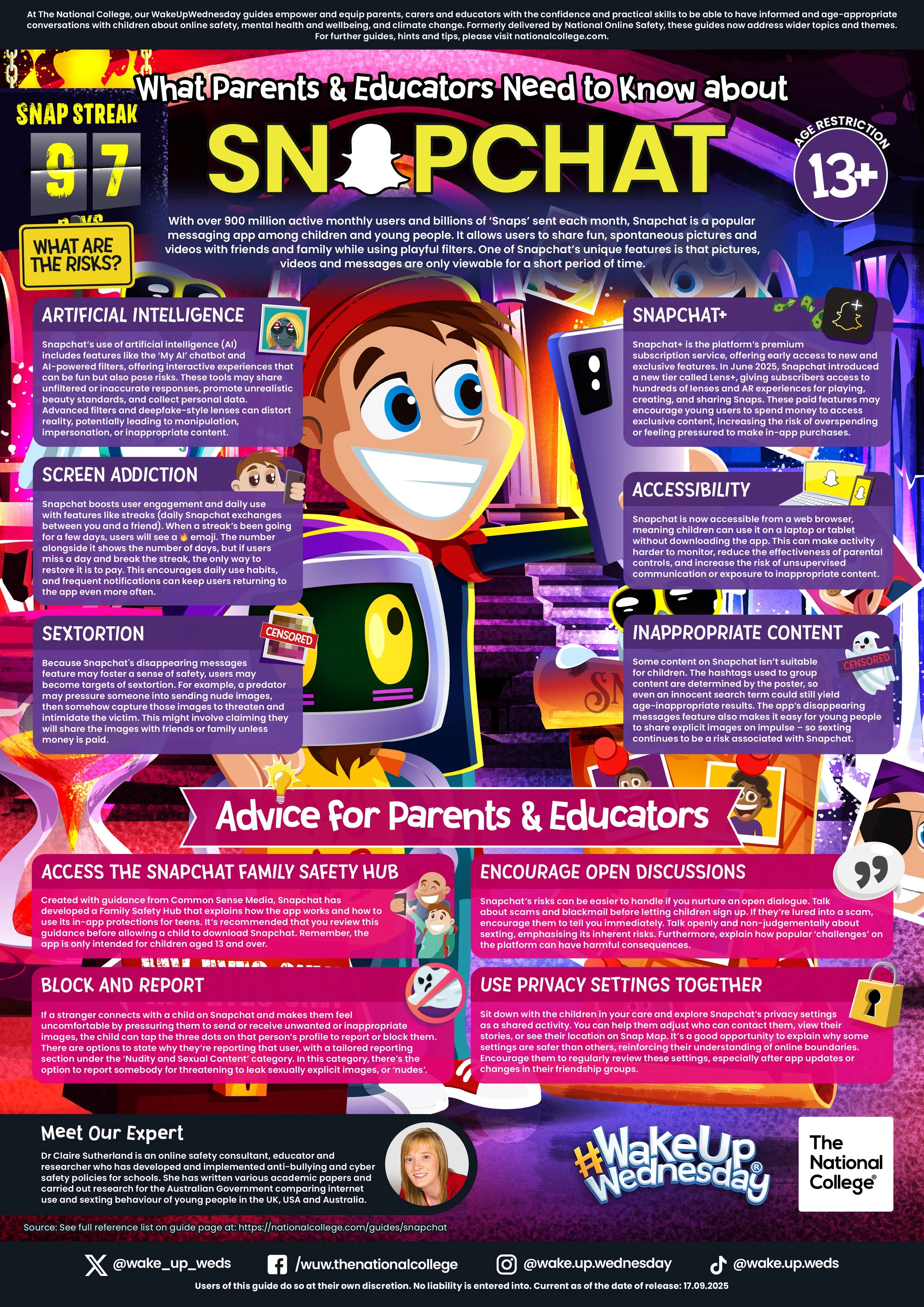
Here is a short Snapchat 101: What Parents Need to Know:
Snapchat is a mobile application focused on visual, temporary communication. Its ephemeral nature (the fact that photos and videos are designed to disappear shortly after being viewed) is its primary draw, fostering a sense of spontaneous, fun interaction. Key features include:
Snaps: Photos or videos sent directly to friends that vanish after viewing.
Stories: A 24-hour broadcast of Snaps visible to a user's friend list.
Snap Map: An interactive map showing real-time locations; it is "Off by default" for teens but easily enabled.
Snapstreaks: A counter tracking consecutive days two friends have exchanged Snaps, often used as "relationship currency."
Spotlight: A public feed showcasing community-generated short videos.
My AI: An in-app chatbot powered by OpenAI that users can message directly.
To support our children, we must acknowledge both the creative affordances they love and the pedagogical challenges we observe in the classroom:
Benefits:
Social Interaction: Reduces barriers for introverted, isolated, or house-bound students; helps them find "instant support" in niche communities.
Mood Lifting: Accessing ‘funny’ content and receiving likes can be affirming; sharing creative Snaps with filters/lenses is an easier, more fun alternative to texting.
Challenges:
Cognitive Impact: Linked to shorter attention spans and lower literacy due to the habit of using "text speech" and incomplete information in sentences.
The Trap of Fatalism: Children often feel trapped on the app. They may wish it didn't exist, but feel that leaving would result in "social ruin" - a total exclusion from their peer group.
Managing a child’s phone use at night is a significant challenge for parents, and the consequences are evident in school. Frequent night-time checking leads to sleep deprivation, daytime exhaustion, and difficulty concentrating. Physically, students experience eye strain and neck pain due to poor phone posture. Furthermore, we must be aware of self-harm challenges that can circulate rapidly through Snaps before adults are even aware they exist.
Snapchat drives metric-based anxiety through quantifiable features like Likes and Snapstreaks. These allow students to measure their social standing, which can lead to significant stress when the numbers decline. We also see a snowballing effect of online exclusion: when a child is excluded from a group chat, this follows them home. Because the phone is always on, there is no safe space, and the pressure of perfectionism from filtered images can lead to deep-seated insecurities.
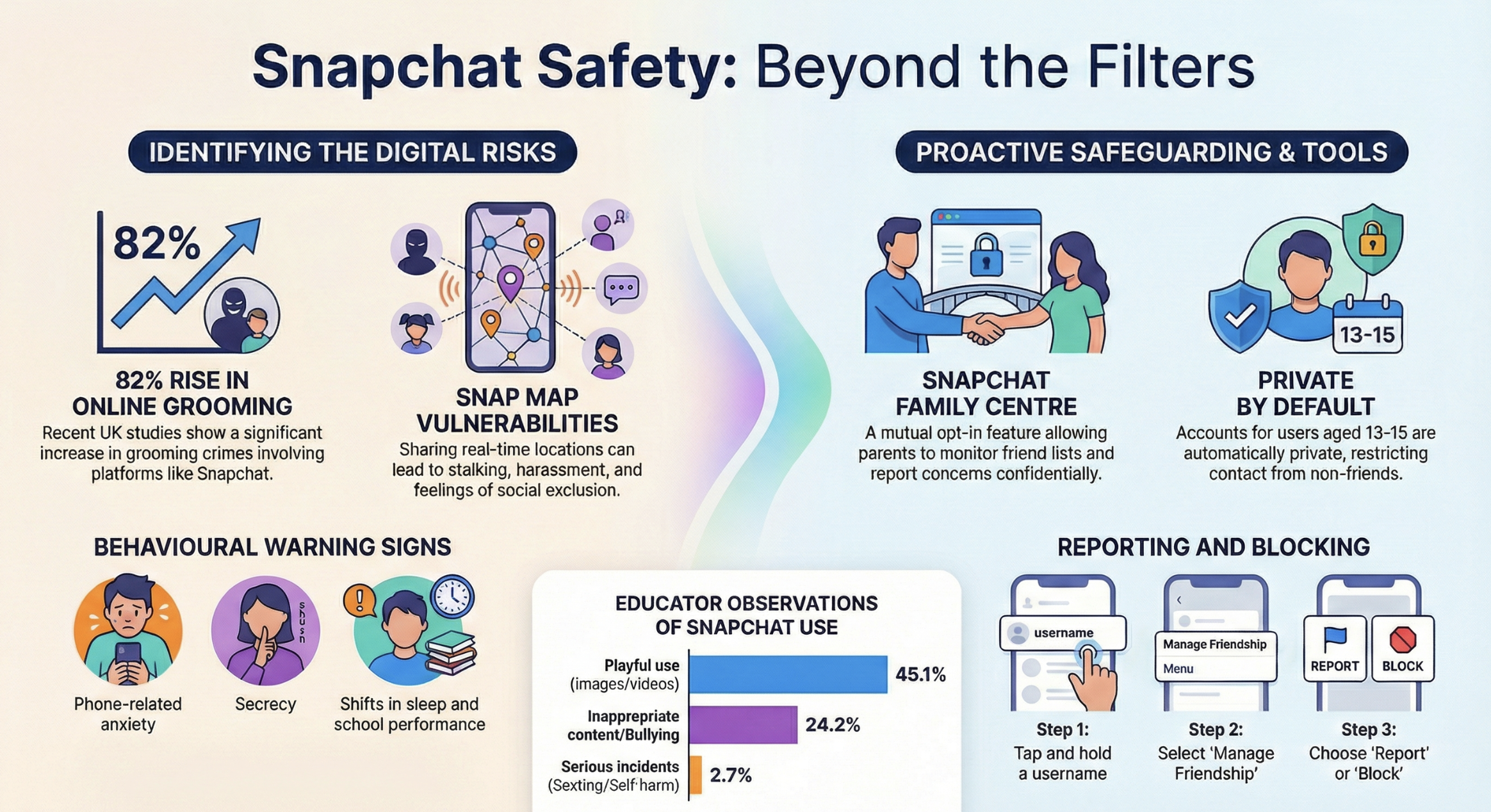
External risks are also a serious concern. Data shows an 82% rise in online grooming crimes over the last five years, with many originating on Snapchat. Predators use username searches and location sharing to initiate contact that quickly becomes personal. Additionally, the Discovery tab is not fool proof; children can easily encounter sexually explicit content, graphic violence, or sextortion schemes in which intimate images are used for coercive control.
Warning Signs: What to Look For
If you notice behavioural shifts, your child may be struggling with their online life:
Anxiety or distress when away from their phone or unable to check a Snapstreak.
Changes in habits: sudden shifts in sleeping or eating patterns.
Academic decline: grades dropping or a sudden desire to avoid school.
Secrecy: receiving unexplained gifts or becoming highly protective of their screen.
Withdrawal: becoming less sociable or losing interest in hobbies like sports or art.
The Toolkit: Managing Risks and Safety Features
Family Centre: This tool allows you to see who your child is talking to without reading the private content of their messages. Important: you must have your own Snapchat account and send an invite to your teen. It requires a mutual opt-in, meaning your child must accept the invitation for you to see their friend list and restrict sensitive content.
Privacy Settings: Teen accounts are private by default. Ensure Snap Map location sharing is set to Ghost Mode. Note that while location is off by default, it can be accidentally enabled; verify this in the "Privacy Control" menu.
Reporting and Blocking: Tap and hold on their username, select Manage Friendship, and find Report or Block. To report a Snap specifically, press and hold on the content and select "Report."
Family Media Agreement: Create a digital agreement that treats the phone as a tool with clear boundaries. Establish phone-free zones, such as the dinner table or keeping all devices out of bedrooms overnight, to ensure a healthy balance between rest and screen time.
Be a Role Model: We cannot really ask our children to put their phones down if we are not modelling the same. Try getting off the grid together with an activity, like baking a cake, playing a board game, going for a walk without devices, or having daily family reading time.
Communication over Confiscation: Tips for Open Dialogue
Research from the Children’s Commissioner shows that talking early and often is the best defence. If a child fears their phone will be taken away as a punishment, they will hide problems until they reach a crisis point. Here are some conversation starters:
"What did you see on Snapchat today? Anything funny or strange?"
"Who do you feel comfortable talking to if something goes wrong online? It doesn’t have to be me, but I want to make sure you have a support network person."
"What do you think might worry me about you being online, and what worries you about me?"

Signposting: Where to Get Help
Here For You Tool: An in-app Snapchat resource that provides mental health support; it is triggered automatically when a user searches for terms like "anxiety" or "depression."
Childline/Internet Watch Foundation: Use the "Report Remove" tool if you are worried a nude image or video has been shared.
NSPCC: For expert advice on handling bullying, harassment, and toxic body image.
Technology will continue to evolve at a startling pace, but our role as parents and teachers cannot be outsourced. The most powerful tool in our parenting arsenal remains unchanged: the meaningful conversation. Equipping our children with critical thinking is more effective than any software filter. It is a responsibility and a privilege that belongs to us, not to tech companies or schools. Be firm, be kind, and trust your instincts. By staying curious and involved rather than just reactive, we create a culture of openness that protects our children far better than any software ever could. Let’s ensure that in the world of smart tech, we are the ones making the safe choices.”
Learn More:
— Mr David Clarke, Deputy Head (Academic)